







The universal candidate profile
The Definition, How It Works, and Why It Matters for Staffing Firms
Definition: A universal candidate profile is a portable, candidate-owned record that follows a job seeker from employer to employer, storing their contact information, preferences, and application history so they never have to start from scratch. Think of it like an e-commerce wallet where your information is available when you need to make a purchase.
Key takeaways
The problem with how candidates apply today
Every job application starts the same way. Name. Email. Phone number. Location. Upload your resume. Answer some questions.
Now do it again. And again. And again.
The average job seeker applies to dozens of roles before landing one. On every application, they're entering the same information they've entered a hundred times before.
The experience is indistinguishable from the first time, even if they applied to the same company six months ago. Nothing carries forward. Nothing is remembered. Every employer, every application, every time - zero.
This isn't a candidate experience problem in the abstract. It's a conversion problem. The moment between "I'm interested in this job" and "I completed the application" is where candidates drop off.
The longer that moment takes, the more of them do. High-volume staffing verticals - healthcare, light industrial, food service - feel this acutely. Candidates are often considering multiple opportunities simultaneously. The one that removes the most friction wins.
Job boards recognized this problem years ago. Indeed has candidate profiles. ZipRecruiter has them. LinkedIn has had them since the beginning. The friction of re-entering information is real, and large platforms invested heavily in reducing it - for candidates who apply through their platform.
That last part is the catch...
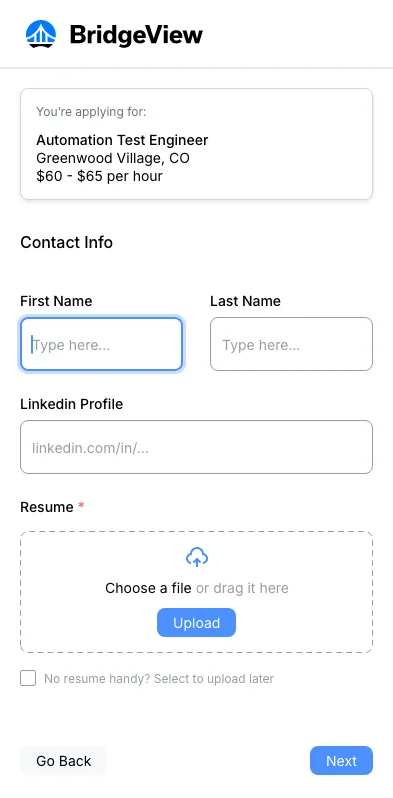
First Application
No data pre-filled. Applicant provides application information and presented with opportunity to save for a 'faster checkout' next time.
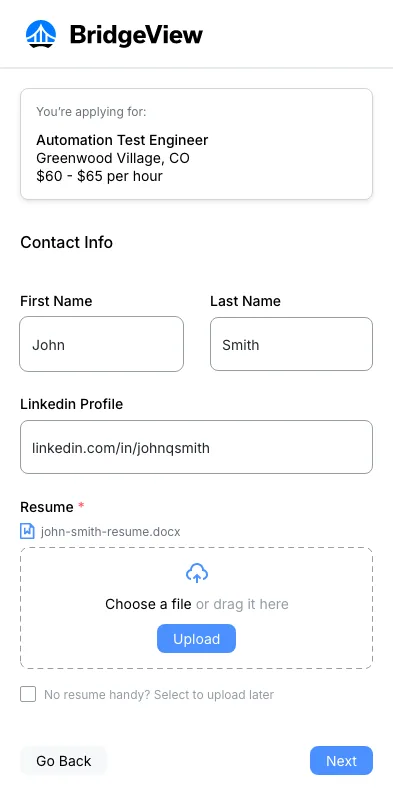
Additional Applications
Personal information that follows the candidate is pre-filled for a better experience and less tedium than compared to normal applications.
The job board model vs. a universal candidate profile
When a candidate creates an Indeed profile, that profile lives on Indeed. It works on Indeed. It is, in every practical sense, Indeed's asset - not the candidate's. The candidate can use it to apply to jobs listed on Indeed, and that's the extent of it. The moment they apply to a job somewhere else, they start from scratch again.
For employers, the arrangement is equally one-sided. The candidate profile infrastructure that makes Indeed useful - the matching, the stored preferences, the application history - belongs to the platform. Employers access it by paying for it. The relationship between the employer and the candidate runs through Indeed, on Indeed's terms.
A universal candidate profile is a different model. The profile belongs to the candidate - not to any platform. It travels with them. When they apply through a network that supports universal candidate profiles, their information follows them from employer to employer, regardless of which employer they applied to first. The network is the infrastructure; the candidate's data is their own.
For staffing firms, this matters in both directions. Candidates who carry their own profile apply faster and drop off less - the same conversion benefit that job boards built their businesses on, without the platform dependency. And firms get the features that made job boards compelling - candidate profiles, matching, job marketing - operating in a system they control, not one they rent.
What exactly is a universal candidate profile then?
A universal candidate profile is the infrastructure that makes candidate information portable.
The first time a job seeker applies through a platform that supports universal candidate profiles, their information is captured and stored - contact details, job preferences, screening responses. A profile is created on their behalf. They don't have to sign up for anything or take any extra step. It happens as part of the application they were already completing.
Every application after that, on that same platform, starts with what's already known. The candidate enters their email address. The platform recognizes them. Their contact information pre-fills. Their preferences are already there. They answer only what's new - the questions specific to this employer, this role.
The mental model isn't a resume. It's a wallet.
When you check out through Shop Pay on a Shopify store, your payment and shipping details follow you from merchant to merchant. You don't re-enter them. You confirm them. The first checkout requires effort; every subsequent one is nearly effortless. A universal candidate profile works the same way for job seekers. The first application requires full effort. Every one after that builds on it.
What the profile contains
A universal candidate profile stores two categories of information, and the distinction between them matters.
The first is what belongs to the candidate: their name, contact information, location, availability, general job preferences, and any files they've uploaded - résumé, certifications, work samples. This is the portable layer. It follows them across every employer on the platform because it's theirs.
The second is what belongs to the employer: responses to their specific qualification questions, results from their screening process, any scoring or notes their team has added. This stays with the firm that collected it. It doesn't transfer to another employer, even one on the same platform.
This isn't just a privacy consideration - it's the right model. A staffing firm's screening process is proprietary. The questions they ask, the criteria they evaluate against, the signals they look for - those are competitive assets. A candidate who applies to two staffing firms in the same network should get a clean, fresh screening experience with each of them. And each firm should get honest, contextually appropriate answers, not responses shaped by a different firm's process.
Candidates also get something most hiring processes don't give them: visibility. A universal candidate profile typically lets candidates see the jobs they've applied to and where they stand in each process - without having to email a recruiter to ask.
Why this matters for staffing firms
Staffing firms have always known that candidate experience affects conversion. What's changed is that the tools now exist to do something about it at scale - without routing every candidate through a job board to get there.
The profile features that made Indeed and ZipRecruiter powerful aren't proprietary to those platforms. Candidate matching, stored preferences, application history, job marketing - these are capabilities, not monopolies. A universal candidate profile brings that same infrastructure to staffing firms directly, operating within their own pipeline rather than as a line item on a job board invoice.
A candidate who has already applied somewhere on your platform isn't starting from scratch when they come back. Their information is there. The application is faster. The drop-off rate is lower. That's a compounding advantage - not just for individual applications, but across the firm's entire pipeline. Every candidate who completes an application becomes a candidate whose next application is easier.
The network effect compounds this. As the network of employers using the same platform grows, the universal candidate profile becomes more valuable to candidates - which makes them more likely to engage with it, keep it current, and apply to new roles they encounter. Both sides benefit from every new addition to either side. Job boards built their businesses on exactly this dynamic. A universal candidate profile makes it available outside the walled garden.
There's also a data quality dimension. Information that candidates maintain themselves tends to be more accurate than information a recruiter entered from a résumé three years ago. When a candidate updates their availability, their preferences, or their contact details in their profile, that update is immediate and self-reported. Staffing firms that rely on candidate-maintained data work with a more current picture of their pipeline - without having to pay a platform for the privilege of accessing it.
Why this matters for staffing firms
The concept isn't new. What's new is the application to staffing.
Universal accounts and portable identity have existed in consumer technology for years - in e-commerce checkouts, in social logins, in payment wallets. What's taken longer is someone building that infrastructure specifically for the candidate side of a staffing workflow: designed for high-volume hiring, built to connect to the ATS systems staffing firms actually run, and structured around the privacy model that multi-employer networks require.
Boostie launched universal candidate profiles for staffing firms over a year ago. What that experience has shown is that the concept works the way the theory predicts: candidates who have an existing profile complete applications at meaningfully higher rates, firms get more accurate data, and the network becomes more valuable as it grows.
It's early enough in staffing that firms adopting this model now are ahead of the market. It's proven enough that the question isn't whether it works.